Friday, January 11, 2019

1/10 Wet Stuff Growing in Eugene, Oregon

The part of Oregon I am staying in for the winter is really wet.  It gets about 46" of rain each year here, but unlike Michigan where I am from, it comes here almost entirely in the late fall and winter.  In fact, it has rained almost every day since I came here in late October.  For example, compare these two weather charts:
  • Ann Arbor, MI - https://www.usclimatedata.com/climate/ann-arbor/michigan/united-states/usmi0028 
  • Eugene, OR - https://www.usclimatedata.com/climate/eugene/oregon/united-states/usor0118
Notice also that the weather has more extreme highs and lows in Ann Arbor, compared to Eugene.  Eugene gets frost and a few freezes, but the ground does not freeze.  

Anyway, while it rained last night (as usual), the sun came out for a few hours today, so I marched off to do my laundry in the RV park laundromat.  While I was out, I took some photos of the stuff growing here in January.

I took this photo walking back from the office, where I went to pick up a couple of packages and my mail.  There are still a lot of clouds, but the blue sky is unusual!  Notice that the trees are leafless, but the grass is green and the pavement is still wet from the overnight rain.  (The grey-green stuff in the distant trees is oakmoss, by the way, not new leaves. See below for details on this moss.) 
 

The first thing I noticed is the moss (or lichen?) on the side of this tree.  Must be the north side??

Here is a closeup.  
 

I don't know what kind of a shrub this is, but it has large buds on it in preparation for warmer weather. 


There is even moss growing on the side of the roadway!   Notice the stick on the lower left that has something grey-green growing on it. 
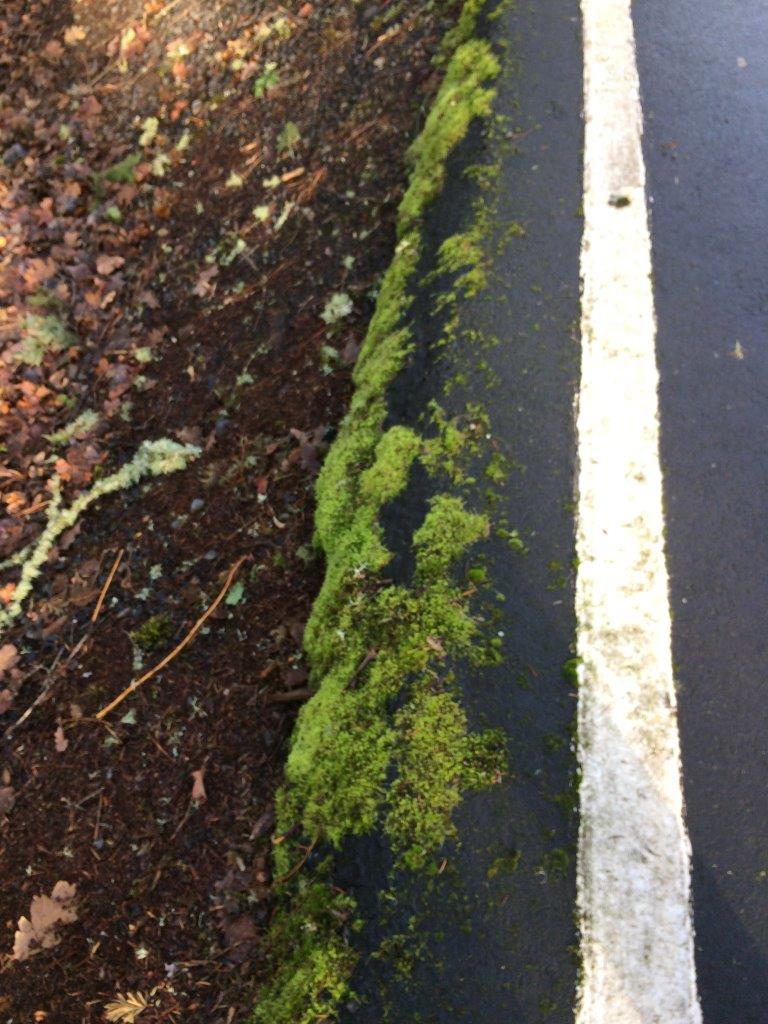
My motorhome is on the right.  

This is a small, ornamental tree growing next to my site.  Notice that it has something growing on the branches.  

A little research showed me that this is Oakmoss, which means this little tree must be a variety of oak:  https://www.inaturalist.org/taxa/123175-Evernia-prunastri.  Actually, it is really a form of lichen, in spite of its name.  What is interesting is that it reminds me a lot of a kind of tree lichen found in Florida and called "Old Man's Beard."  Here is an article on it:  http://www.wildsouthflorida.com/old.mans.beard.lichen.html#.XDgx4Wl7mpo 

Neither of these plants causes any damage to the trees because they get their nutrients and water from the air and stuff that lands on them.  And strangely enough, they are used by the French perfume industry.  I will have to sniff a sample on the next sunny day.  

A lot of plants in Oregon remind me of the ones in swamps in Southern Georgia and Florida--lots of ferns, moss, and lichen.  Here is a closeup of the small tree.     

This is a very well-cared-for and nicely landscaped RV park.  As you can see, the daffodils are also waiting for spring!  

I am hoping to be back in warmer and sunnier locations by spring, however.  With all the lichens and moss, I am afraid if I stay much longer, I will get covered.  

Monday, January 7, 2019

1/7 My Recipe for Peameal Bacon

Two foods I grew up with are pasties and peameal bacon.  Peameal bacon is what is sometimes called “real Canadian bacon,” but nearly all Canadians call it peameal bacon. You can buy it almost anywhere in Ontario and a few other provinces. Note that I posted some of these same photos way back in January, 2016, but did not include a recipe then.   

There are two problems with the name “peameal bacon.”  The first is that it is rolled in yellow corn meal, not peameal as it was originally, and the second is that it is really not bacon!  Real ground meal made of peas is just not very available anymore, and I have no idea why the name included the word “bacon” because it is made of boneless pork loin.  I had heard that it got that name in WWII because the Canadians sent it to the British who had little meat available during and immediately after the war.  This article gives more details:  https://www.foodnetwork.ca/shows/great-canadian-cookbook/blog/the-history-of-canadian-peameal-bacon/
 
In any case, the important thing is that peameal bacon is preserved by brining, not by smoking, as other bacon is.  This means you need to cook the brined meat, just as you would any unsmoked or precooked pork product.  It makes wonderful sandwiches or breakfast meat with eggs if you just pan fry it in a little butter.  It can also be roasted, although I have never done that.  The point is that this meat does not resemble the smoked and sliced stuff you can buy in this country that is called “Canadian Bacon.”  (Clarification: You can buy the real peameal bacon in a few specialty stores in cities that border Ontario, like Detroit and Buffalo.)

It took some internet searching for recipes and some experimenting to get a recipe that tasted the way I knew it should.  (Hint: If the recipe tells you to smoke it, forget it!)
The pork loin it is made from is the chunk of meat that the pork chops come from, except without the bone.  Do not cut it up or trim off the layer of fat on one side—it is so lean that it needs this fat!  If you don't find a pork loin in the meat case, ask the butcher.  It should look like this and weigh about 3-4 pounds:  


Next, you need a large plastic container with a lid that will hold the meat in one or two chunks and still fit into your refrigerator.  Because I have a very small refrigerator, I cut the pork loin in two pieces and stuff it in a small, square container that will fit.  

Then you need to get some pink #1 curing salt. This is an absolute requirement and cannot be substituted!  You will probably have to go to a specialty spice store to get the pink salt.  Make sure whoever you buy the pink salt from knows you are using it to cure meat, so you do NOT accidentally get Himalayan pink salt, which is entirely different. You can get it from Cabela’s and butcher supply companies.  Amazon carries this as well:  https://www.amazon.com/Boise-Salt-Co-Prague-Gluten/dp/B07JVHSRK9/ref=sr_1_11_s_it?s=grocery&ie=UTF8&qid=1546908012&sr=1-11&keywords=pink+curing+salt+%231
 
While you are getting the pink salt, you might want to get a brine injector, although in a pinch, you can make do with just sticking holes in the meat with one of those long nails you use to tie up a turkey.  Mine looks like this one from Amazon, although there are nicer stainless steel models:  https://www.amazon.com/Ofargo-Plastic-Marinade-Injector-Download/dp/B078CQ3369/ref=sr_1_cc_4?s=aps&ie=UTF8&qid=1546908399&sr=1-4-catcorr&keywords=brine+injector     

When you have the container, meat, and pink curing salt, gather the following:

  • 3 quarts cold water
  • 1 cup maple syrup (The real stuff! No substitutes.)
  • 3/4 cup kosher salt
  • 2 tablespoons Prague powder #1 cure (pink curing salt)
  • 2 tablespoons of pickling spices
  • 1 tsp garlic powder (optional)
  • 1 cup yellow cornmeal
Put the water, maple syrup, kosher salt, pink curing salt, and pickling spices in a pan and bring them to a boil.  Take off the stove and stir to make sure all the salt is dissolved.  Cool and pour all but one cup over the meat in the plastic container.  

Fill the brine injector with some of the reserved brine and inject it into the meat about every inch.  It will drip out, so this is best done in the container or over another container. 
When you are done injecting the meat, dump the remainder of the reserved brine onto the meat in the container. Put the lid on and put the container in the refrigerator.  Let the pork loin sit in the brine for four full days.  Hopefully, the brine will cover the meat entirely, but it is always a good idea to turn the meat every day.  If the meat is floating in the brine and not covered, you could add something heavy, like a clean plate, to weigh it down.  

After four days, take the meat out of the brine and dry it off with paper towels.  Then roll it in the cup of yellow corn meal and let it sit for a couple of hours in the refrigerator.  I use a plastic bag to coat the meat with the corn meal--much less messy. 
At this point, I usually cut off several slices for immediate cooking and then cut the rest of the loin into a couple of chunks and freeze it.  Slices should be about 1/3” thick, no thinner, or it will cook too fast and not be juicy.  
 
Fry in butter at medium heat until the meat is no longer a dark pink.  The photo below shows the dark pink color of the meat before it is cooked.   

Thee next two photos show how it should look when cooked.  I don’t like it overcooked, so I cook it just until done, as shown in the first photo, but others like it a little more cooked, as shown in the second photo.  (The top piece here was really cut too thin. The bottom piece will be a lot more juicy.) 


Some people like to put mustard on it in a sandwich, but I like it plain.  It also goes well with eggs at breakfast, but make sure however you eat it, that you eat it hot from the pan.


Sunday, January 6, 2019

1/3 U of Oregon's Museum of Natural and Cultural History

I have been incredibly bored lately, mostly because it has been too cold and rainy to go outside or do much of anything and also because I am sitting around waiting for approval to start a new medication.  The sooner I can start this new medication, the sooner I can resume my travels to warmer and dryer places!!  So, I rented a car for a week and spent a few hours one day visiting this nearby museum. (There is also a museum I might visit in Portland, but I decided it was just too damp and dreary for that long drive.)   

Anyway, this museum on campus was small and not very expensive, so I decided to give it a try.  And because classes do not start for a few days, there was also lots of street parking right in front! 


There are two halves to this museum--one focused on natural history and one on the culture of the ancient people who lived here thousands of years ago.  

The sculpture on the top of the entrance to this building is a migrating male salmon.  These fish change the shapes of their mouths and even their backs as the swim up rivers.  Once they fertilize the eggs that females lay, they die.   

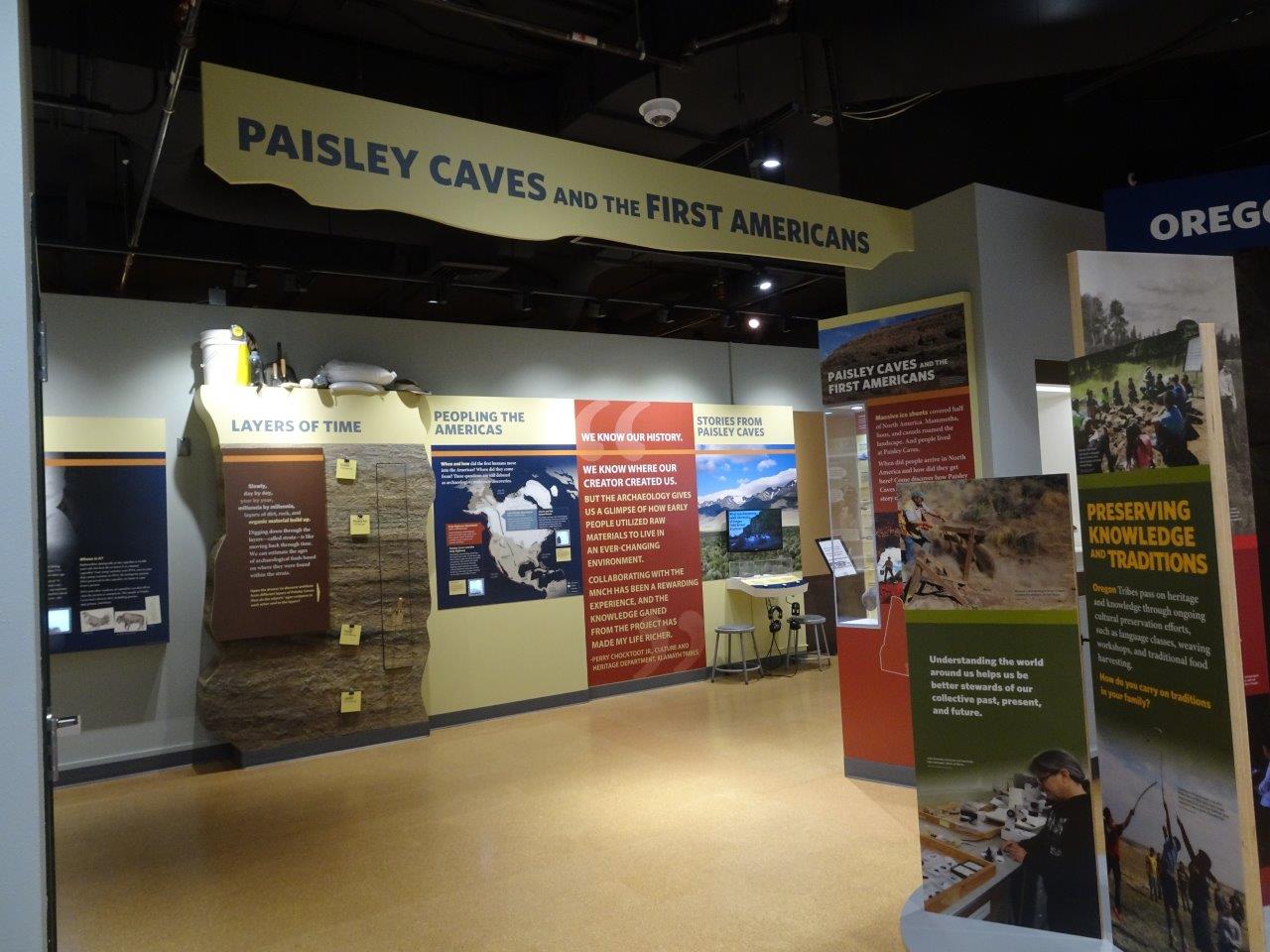
This is the cultural side of the museum.  Paisley Caves is where they have found bones and artifacts of some of the oldest Americans--over 9,000 years old!  So, the focus in this museum is on these ancient peoples instead of the more modern Native Americans who lived here only hundreds of years ago.  


It is amazing that these sandals made of sagebrush bark have lasted over 9,000 years in such good condition!  And they have several pairs on display--mostly the same design but in various sizes. 

Here is an article about these sandals and where they were found.  https://oregonencyclopedia.org/articles/fort_rock_cave/#.XDKWH2l7mpo  

The shoes on the lower left have rabbit skin woven in to make them warmer.  Rabbit skin was cut into long strips and used to make woven blankets and coats as well as shoes.  

And a reconstruction of an early shelter.  

A fragment of an 9,600 year old basket.


This reconstructed plank home represents a later group of peoples.  Northwest peoples have long known how to split logs into rough planks to build their homes.  A fishing trap is next to the building. 

These are some of the tools and artifacts found in Oregon.  Notice that the basket on the upper right is made of strips of wood, not woven from plant fibers as most baskets are.

I thought this was an interesting map of Oregon.  Like Michigan and much of the Midwest, Washington and Oregon experienced glaciers that mostly wiped the landscape clean, so there are no dinosaurs and very early animals or plants found in these states.  However, the geology is varied because of the Cascade mountains, volcanoes, and other events that occurred both before and after the glaciers.  

As you can see, I spent most of my time on the Cultural side of this museum.  The next few photos were from the Natural History side, but I really ran out of time here.  

This is a model of a large ground sloth, one of the animals that survived the glaciers and was hunted by ancient humans.


And another interesting map showing ancient animals and where they have been found in this state.  There are a lot more models and bones of these animals at the Thomas Condon Paleontology Visitor Center in the John Day Fossil Beds National Monument.  It is located about 100 miles east of Bend, Oregon.  Check my posting on 10/3/2018 for photos.

I spent a couple of hours here and could have spent more time, but I wanted to run the rest of my errands and get home before dark.  Well worth the $3 entrance fee for seniors.

1/1 University of Oregon Tour

I have been VERY lazy and sitting on these photos throughout the holidays. A very kind lady who teaches at the University took me to lunch and gave me a short walking tour of the campus. It was a short tour because it was cold and damp, as is usual for this time of year.  Some day when I am here, and it is warm and sunny, I will take advantage of Eugene's many bike trails and do some exploring on my own.  And, I confess that this happened way back on December 13!! 

The University of Oregon is the largest university in Oregon and its flagship, so to speak.  It was founded in 1875 and currently has about 19,000 undergrads and almost 4,000 graduate students. Their teams are the Ducks, and you can see a lot of Duck memorabilia on people and around town.  One thing that having such a substantial university in town is that there are more cultural programs and a lot more upscale stores than you would expect in a city the size of Eugene.  

This is where we had lunch.  It is a very interesting looking bed and breakfast and restaurant.  

Looking from the commercial area into the campus. 

Just a sample of some of the buildings.  Looks pretty much like a lot of other colleges. 


I thought this building was interesting because it looked a bit like it came from Amsterdam in the Netherlands. 

Those of you who are familiar with my alma mater, U of Michigan, can you imagine actual street parking right in the middle of campus???  Amazing!  


Apparently, a lot of the trees were planted on campus.  What is surprising on this one are the ferns growing on the large branches.  The tree was labeled as a large-leafed maple, and these ferns look a LOT like the ones they call resurrection ferns in Florida.  They are called that because in dry weather they dry up and look dead, but in a few short hours after a rain, they become green and look alive again.  I will have to check these out in the middle of a dry summer.  

Directly behind this tree, as shown above, is Deady Hall, one of the oldest buildings on campus.  This building is said to be haunted and it looks like a good candidate for a horror movie, but very interesting architecture. 


The fern tree is in the background, just in front of Deady Hall. 

This is a statue of "The Pioneer" and was dedicated in 1919, so almost a 100 years old.  

If this looks familiar, it is because it is the main library.  Reminds me of a lot of libraries, including the main Detroit library and the one in Ann Arbor.   

 Eugene is an interesting town that is enriched by having a major university.  I have been given a map of its many parks and bike trails, so someday I will do more exploring.


Sunday, December 23, 2018

12/23 Almost Christmas and the End of the Year

So, what have I been doing lately?  Mostly, not a lot.

It has been raining here in Oregon almost non-stop, and it has been chilly even during the day, so I can't go out much. So, I have been doing some cooking, some cleaning, some sorting, and working on some projects that I have put off for a long time.  One was scanning and desktop publishing a cookbook from the mother's club of my elementary school.  It was put together in 1955 and has so many of the names I remember--relatives, neighbors, and relatives of classmates.  That project took me three days and at least 15 hours. I have also been busy getting my winter class ready for the new semester.  

I seem to have recovered from my kidney stone problems, but will not know for sure until I get the results of the cat scan that was done a week ago.  Other issues are also resolving, which means that as of January 31, I will be able to head south to get out of the rain and into slightly warmer California for a while.  That will feel really nice!  

Also, I have been thinking about how long I have been living in this small space and traveling.  It has been several months over six years since I sold my condo, put my stuff into storage, and took off on the road.  When I started, I was not sure I would like to do this kind of traveling long-term and told myself that I would commit to at least two years.  I was not sure if I would be bored or lonely or feel claustrophobic living in this roughly 10' by 28' space.  (That is an estimate with both slides out and not counting the cab part of my vehicle.)   I have lived in a 1,000 square foot house, a 2,000 square foot house, and an 1,800 square foot house, but I feel just as comfortable in these 280 square feet as in all of those.  

I COULD use more storage space and more cargo carrying capacity so I could bring more stuff, but I have all the essentials to make me comfortable.  (Cargo carrying capacity is the amount of weight your RV can carry without overloading the frame and tires.  It includes people, fresh water and waste in tanks, belongings, even gas in the gas tank.)  I am at the very top of my cargo carrying capacity, so I have to be careful of what I accumulate, and I cannot drive with more than a quarter of a tank of fresh water.  I am also getting tired of so many things breaking in this motorhome and having to spend so much money of repairs.

But, I have a very comfortable bed, my old leather recliner that fits me perfectly, a refrigerator and freezer full of food, a kitchen that enables me to cook and bake, even if my oven is small.  I have two internet mobile hot spots and satellite TV, so I am well-connected with the outside world. Also, I like that I have lots of windows and a good view of both sides and through the front windshield from my recliner.  Being able to look out makes it feel a lot less cramped inside.  And of course, it helps that being able to keep moving means that my views from my windows are never the same for very long. 

While I enjoy seeing new places, I also have found some favorite places where I feel comfortable and I enjoy visiting.  Most of my favorites are in beautiful places.  And many others have wildlife to watch.  For example, I am planning to go to the Las Vegas area in March so I can stay at Valley of Fire State Park and visit Willow Beach Marina.  

How much longer do I want to live the life of a vagabond?  As long as I possibly can.  I am hoping for another five years, assuming my health and money holds out!  Keeping my fingers crossed.       


Tuesday, December 4, 2018

12/4/2018 Update on my Life

So, several things have happened to me lately--some good and some not-so-good.  I have been very busy grading papers and getting ready for the upcoming winter semester, and it has been too cold and rainy to do much sightseeing in this area, but I do want to visit the university museum when I get a chance.  I also want to rent a car and go for a drive up to Portland.  

Most of my medical issues are getting resolved, but two things I did not expect have happened lately.

First, I went to the LensCrafters store at the Eugene Mall to get a new left lens in my glasses.  My eyes have been getting tired lately, and I had noticed that my left eye was getting worse.  I have really had problems reading and grading students' papers online and had to take a lot of rests.  And it has been two years since I had a new prescription, so the solution seemed evident--new prescription and new lenses.  Except, the ophthalmologist told me that It would be useless because what I really needed was cataract surgery and an eyelid lift.  I've known for some time I had a mild cataract in my left eye, but it had never bothered me before, so figured I would get it done next summer at Cleveland Clinic when I was visiting my younger son and his family.  

I also knew that eventually my eyelids would continue to droop, and I would need a lift, but like the cataract surgery, I figured I could put it off for a few months or next summer, at the earliest.  So, now I need to find someone to do the surgery near here.  Got one recommendation, but other things have interferred--like Situation #2.

So, the second thing was that a few weeks ago, I had a cat scan for some unrelated issues.  This cat scan with dye showed clearly that my left kidney was not working well and that I had two collections of stones.  One was in the ureter, near the bladder and was clogging the flow of urine, which is why my kidney was not functioning well.  And the second group was a little nest of stones in my lower kidney that was in a place that meant they could not easily pass. 

So, a couple of weeks ago, I made an appointment at a urologist, and after looking at the cat scan, they got me scheduled into the hospital to get them out--fast!  I have been a regular kidney stone former for over 35 years, but have not really had any pain with these last ones, which puzzled me, although I did have some back pain I blamed on muscle spasms. But it was not constant and did not feel like kidney stone pain, so this one completely missed me. 

So surgery was scheduled for last Thursday afternoon.  They went in and discovered the lowest stone had already passed, but they used a laser lithotripsy to blast the "nest" of stones in my lower kidney.  It meant general anesthesia and an overnight in the hospital on an uncomfortable bed, but it had to be done.  They put in a stent from kidney to bladder to help them pass, but I have had stents in the past and they typically cause pain and a lot of bleeding.  It did not help that my platelet count has been very low, making the bleeding worse, but no choice in postponing.  

So, I have spent the last few days mostly sleeping or sitting in my recliner.  I made sure I had plenty of food, water, propane, pain meds, and stuff before all this started.  But today, I had to go out to get blood tests done, and drove, plus I also did some grocery shopping--big mistake.  I have to go out tomorrow to get the stent removed, but I think I will take Uber because I had a lot of pain after getting home this afternoon.  Basically, the doctor said to focus on being a couch potato for the next few days, which I need to do a better job at.  

I am feeling much better right now, after dinner and a pain med chaser.  Got papers to grade, but luckily that is easily done while sitting. 

So, "they" tell me cataract surgery is very easy these days, but I think I am going to wait a bit before tackling that item on my to-do list.  I also really need to get a colonoscopy and a breast exam, but those are on the back-burners also.  At least I am in a place with lots of good doctors.  But, I am still anxious to head someplace warmer and sunnier as soon as I can!   

And speaking of staying warm--I got two new electric heaters that really do a much better job of keeping me warm.  They use the same number of watts, but blow the air around better, plus they have an extra safety feature.  Nearly all small electric heaters have a feature where they shut off if tipped over.  These also turn themselves off if they overheat, which is a concern when you live in a small place.  

It is going to drop down to 26 degrees tonight, and I have filled my fresh water tank and unhooked the water hose to prevent it from freezing.  I also wrapped an old towel around the area in the utility cabinet  where the sewer hose exits to keep cold air out.  There is furnace duct in that compartment which should prevent freezing down to around 20 degrees, so I should be OK. 

Wednesday, November 21, 2018

11/21 Brrrrrrrr! Liviing in an RV in Cold Weather

OK, I know what is cold to one person is not cold to another, but if you notice, nearly all RVers who live full time in their rigs head for warmer places in the winter.  So, why can't you stay in colder places?  People do it all the time in house trailers or "mobile homes."  

There are several big reasons why you cannot spend the winter living in an RV in places like Pennsylvania, Michigan, Ohio, or even Kentucky or Kansas. 
  • First, RVs are not insulated anywhere near as well as mobile homes.  The walls are only 2" thick and you can't add any more insulation since the walls are made of pressed foam with no extra spaces.  Your "sticks 'n 'bricks" home has at least 4-6" of insulation in walls. 
  • Second, very few RVs have double-pane windows, so there is a lot of air leakage around windows.  And the ratio of windows to solid walls is more than in a home or mobile home. 
  • Third, slides leak air.  All of them.  There is only a thin piece of rubber that surrounds most slides, and it is not unusual to have gaps in that rubber weatherstripping.  I have one space that is 1" by 1" where I keep a rag stuffed in mine.  If you want to test air leakage around slides, park sideways next to a 65 MPH wind as I once did.  Even when I put my slides in, rain and wind came in under, over, and to the sides of the slide facing the storm.  It took a lot of towels to sop it up.   
  • Fourth, even with skirting, which most people do not put around RVs, fresh water and sewage tanks are exposed from underneath.  You can last a few hours at maybe 28 degrees, but any colder or longer, and you are likely to have frozen pipes and frozen hoses, and frozen sewage! 
  • Fifth, it takes a lot of propane and electricity to keep your RV warm, no matter what kind it is.   
So, I am staying in mid-Oregon for a couple of months to get some medical things taken care of.  This is a relatively mild climate for some place so far north because of the closeness of the ocean and other weather factors.  It gets below freezing here, but only during the nights and then warms up during the days. It is only November, and I can already see that this is going to be a chilly winter.  Highs during the day have been about 50-60 and during the nights has dropped down to close to freezing or a little before.  

I have a 10-gallon built-in propane tank that fuels my hot water tank, stove and oven, and two furnaces--one in the front living area and one in the rear bedroom.  I am also supplementing the furnaces with two small electric heaters. (Bigger heaters would not be safe and might blow fuses.)  My first tank of propane lasted 15 days.  My second lasted only 12 days.  Getting a refill means driving my motorhome out and getting someone who can fill it.  (There are external supplemental tanks you can get, but these require a special fitting, which I don't have.)   And I have been barely keeping the temps at 68 degrees during the day and much lower at night.  

Luckily, I have a really warm down comforter that keeps me warm at night, but getting out of bed in the middle of the night is still pretty chilly.  I am hooked up to sewer, but I have to go outside to pull the handles on my tanks every three or so days.  

So, as soon as I can, hopefully in late January, I am headed for warmer places around Las Vegas and Arizona!   In the meantime, brrrrrrr!  

And by the way, the good news is that it is now raining in Oregon!!  Even better, it is raining in Northern California, so the fires will be going out and the air will be getting a lot better in the next few days.