Thursday, January 18, 2024

1/17 Shark Valley Bike Ride

Shark Valley is part of Everglades National Park, and it is located about 15 miles from my campground, Midway, along U.S. 41, aka Tamiami Trail.  It consists of a 16-mile paved loop road that is accessible to hikers and bikes.  You can bring your own bike or rent one from the concessionaire. If you cannot ride or walk that distance, there is also a shuttle that runs every hour or so, but it's expensive, so I prefer using my electric bike.  I try to go here at least once or twice every time I visit this area in very southern Florida, but the weather has been rainy and drizzly, plus a bit chilly, over the past week that I have been camping here.  

This morning, the sun was out and no rain was expected, so I uncovered my bike, filled up the front tire with air, and headed east.  

First, since this is part of the Everglades National Park, you will need to either pay an entrance fee or show your senior pass, like the one I have.  I had to wait in line today because the parking lot is fairly small, and it was full when I arrived.  I was lucky that there was an available spot in the RV/bus parking area, but I needed help parallel parking.  Got in OK, unloaded my bike, and headed past this visitor center onto the 16-mile loop road. 


I prefer to start off on the east side of the loop because it is less crowded.  In fact, it is amazingly empty most of the time, though there was a little traffic from fellow bike riders today.  Also, note how much water there is in the Everglades.  Last time I was here a couple of years ago, it was almost dry. 


Some views of the loop and the area.  


After about 7 miles, you can see the tower in the distance.  It has a ramp and a great view of the countryside, but I skipped walking up it this year. 

 
I need to find out what this white scummy stuff is.  It looks a lot like the kind of algae that is appearing in a lot of rivers and ponds these days due to excessive farm fertilizer.  

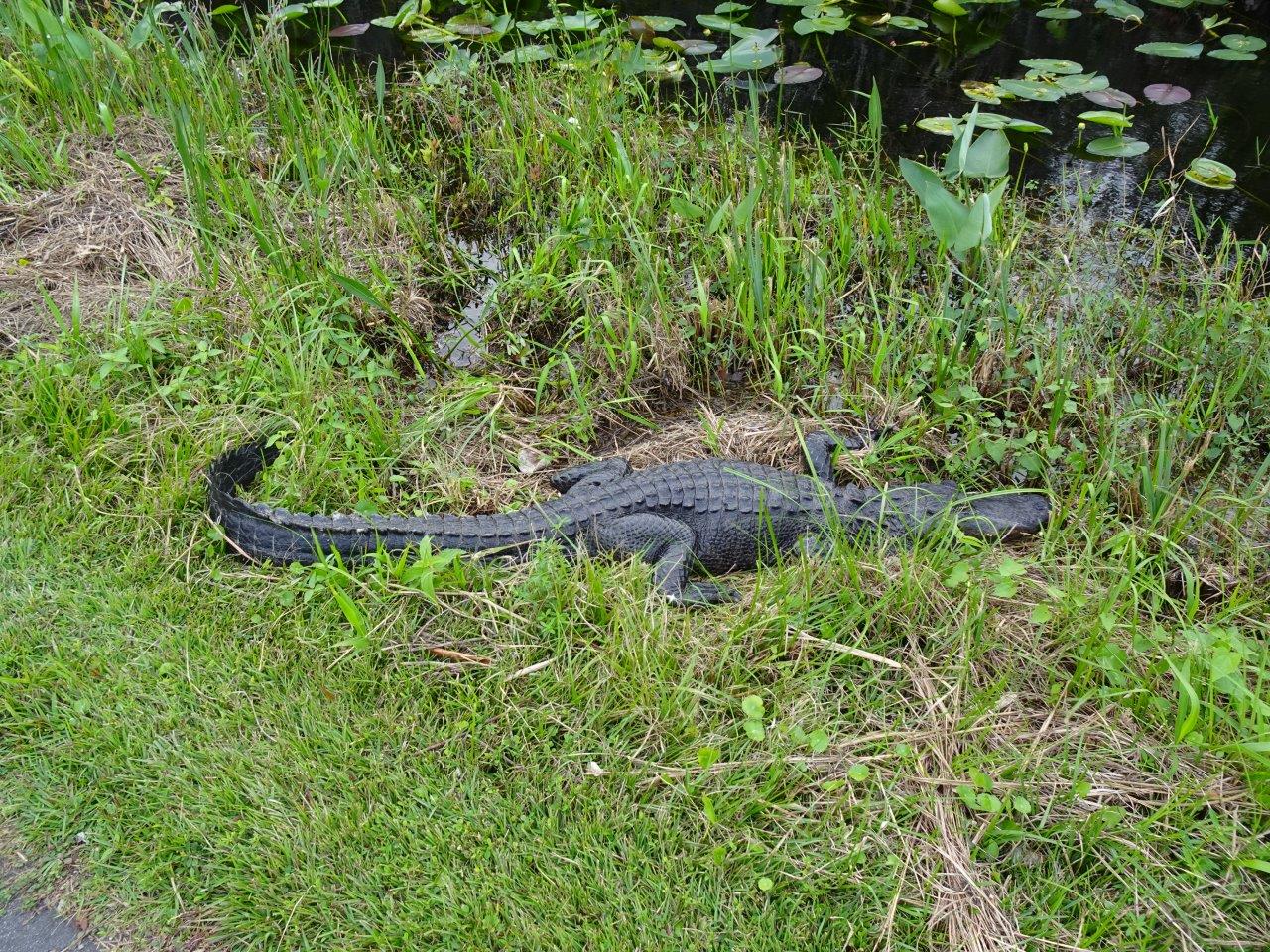
If you are lucky, you will find several alligators sunning themselves along the roadway.  Notice that this can be identified as an alligator by its rounded snout. 

 
I mentioned the above photo as being an alligator by its rounded snout, because below is a photo of the only crocodile I have ever seen in this part of the Everglades.  I asked the rangers about it later and found out that this is a female who showed up several years ago, and seems happy just hanging around this area.  
 
She really belongs in brackish or salt water farther south with all the other crocodiles, but somehow she got here and seems comfortable staying.  She is about 8' long, so fully an adult, but she cannot mate with alligators because she is a different species. 

 
How do we know this is a crocodile, not an alligator?  The main clue is that she has a long, narrow snout and her teeth are visible on the outside of her upper jaw.  
 
Both alligators and crocodiles are equally fast in terms of swimming, but alligators are much more laid-back, while crocodile are more aggressive.  However, unless bothered, it is highly unlikely that either one will chase you as the ones do in the Crocodile Dundee movies!!!  If you find them basking in the sun, it is likely they are napping and have their eyes closed.  
 
On the other hand, almost every pond and puddle in Florida has alligators in it, so do not go swimming or even wading in any watery place in Florida or a lot of other southern states.  Stick to hotel and private pools!!  And if you go swimming even there after dark, turn some lights on and check for visitors before you dive in!  🐊 


This is a much less dangerous Florida resident.  

I came to a screeching halt when i saw this very pretty purple gallinule.  This one is looking for insects and edible vegetation.  They have very long toes on their feet, which they use for walking on vegetation, so you can often find them on pond lily pads and other floating plants.


The west loop road follows a water-filled ditch, so there are a lot more birds on it than on the eastern loop road.  You can see the ditch in this photo.

Looking ahead at some walkers over my bike.

I think this is a lance leaf arrowhead flower.

This is a swamp lily. 

And the last alligator.  Actually, there were a lot more on the trail, but I had not taken my jacket and was very cold, so I did not stop for them all. 


This is one of the best bike trails in Florida, so I strongly recommend you take it at least once or twice each year.  If I lived in Florida, I think I would go during different seasons, also.  There is always something interesting to see.


Wednesday, January 17, 2024

1/15 Midway Campground, Ochopee, FL

This is one of my favorite campgrounds in Florida, in spite of, and maybe because, it has almost no amenities.   Or at least no amenities that many people look for in a campground.  

It can clearly be said to be "in the middle of nowhere" because it is in the Big Cypress National Preserve, on Highway U.S. 41, aka Tamiami Trail, and located half-way between Miami and Naples, FL.   The nearest gas station, along with a convenience store, is located about 20 miles away in the Miccosukee Indian Reservation.  If you want a real supermarket, you need to drive about 50 miles to the Publix store in Marco Island.  

Mostly, there are just a lot of birds and alligators around this place, plus a black bear who occasionally visits the campground, so you need to keep food inside your RV or in a bear-proof storage box provided for you if you are tenting.  It is also very quiet here, especially at night when most of the highway traffic is gone.  It is also extremely dark here, as Big Cypress is a dark sky area, so you are asked to not turn on any outdoor lights at night, so fellow campers can see the Milky Way and millions and millions of stars.  

As you drive past on the Tamiami Trail, you might easily miss this campground sign.  There are other small campgrounds along this road, but this is the only one with electric hookups, so it is very popular.  


Basically, the campground is a loop that circles an alligator pond, shown below.  Alligators do come out on warm, sunny days, to increase their body temperatures so they can digest their food, which is mostly fish from the pond. 


You are asked, however, not to take pets for a walk on the grassy area between the roadway and the pond, and it is strongly suggested that you take a flashlight if you go out after dark so you do not trip over anything.  No picnicking here also, for obvious reasons.


This is my motorhome across the pond.  I took this photo on a daily walk I take around this loop.  


A closer view of my campsite.  It is paved and with both 30 and 50 amp electrical hookups.  I can easily look out my front window at any happenings around the pond. 

Mostly, I just watch birds  like this wood stork who hangs around the pond.


There is also a tent area without electric hookups.  It is empty in this photo, but most of the time it is full of tenters.  On the left side of the roadway, you can see a trailer at the water fill station, which is near the station for dumping tanks.


Almost every camping spot has a palm tree next to it, but this one has been surrounded by a strangler fig, so you cannot even see the stem. 


One interesting thing to do is to walk out to the highway and walk across to the long ditch that was created when the Tamiami Trail was created.  They needed rock and sand to build the roadway up high enough to pave, so they dug a ditch along almost the entire length of the roadway and piled up the removed material to make a road.  The result is a very long water-filled area for alligators, fish, and birds.  People also fish here. 

 
This is what this long pond looks like just on the other side of the guard railing.  The water is extremely clear and full of life.  

 
Two other views of the long ditch.  


Even though you cannot get gas or groceries nearby, there is a famous art gallery about a mile west of the campground. 

The gallery is actually the old home of Clyde Butcher, who is known as the Ansel Adams of the Everglades.  He is in his 90s now, and lives in Naples near another gallery he owns.  His art is not cheap, but it is beautiful.  You can buy a calendar or other items made by local artists.  


I had to stop and take a photo of these two little guys.   The one on the left, I think, is a Florida reef gecko.  The one on the right is a Florida scrub lizard. Unusual to get them both in one photo.

And right next to the parking lot is an alligator that you are not supposed to feed.  You are also supposed to stay at least 15' away from them. 

A closeup of this very awake fellow. 


Saturday, January 13, 2024

1/12 Big Cypress National Preserve & Kirby Storter Boardwalk

The Big Cypress National Preserve includes 729,000 acres of the western part of the Everglades, but it is NOT part of the Everglades National Park.  This does not mean that it is a lesser place or has lesser beauty and diversity of animals.  It was created in 1974 to preserve land that was likely to be developed for a Jetport, homes, and businesses in the huge Big Cypress Swamp.  It encompasses parts of the Seminole and Miccosukee tribal land, as well as some of the most beautiful ecosystems in Florida. 

I discovered this area when I first started full-time RVing and was unhappy with a nearby state park that was cramped and buggy.  I left early and headed east along US 41, which is otherwise known as Tamiami Trail, and found Midway Campground.  Midway is one of my favorite places in Florida, even if it is 25 miles from a gas station and 50 miles from a big grocery store.  I have come here at least once or twice every time I come to Florida because it is so beautiful and there is so much to do, assuming you are interested in birds and animals.  (If you prefer camping "resorts" with pools, kiddie activities, and hot tubs, you need to go elsewhere!)  

On my way here on Tuesday, I stopped at Kirby Storter Roadside Park, which is about 45 miles east of Naples, FL. This place looks like a regular rest area, but the key thing here is a one-mile round-trip boardwalk that takes you through various types of swamp ecosystems. 

I discovered this boardwalk when I was staying at Midway and could not get cell phone service there.  I was teaching online college classes, so I would have to drive out once each day either to this place or the nearby Oasis Visitor Center to get a signal for my Verizon hotspots so I could upload and download student papers and check my email.  Sometimes, I just stayed parked in the parking lot, but other times I would enjoy a walk on the boardwalk to see what birds were hanging around.

First, some photos of the boardwalk.  The part closest to the parking lot is mostly dry and has smaller cypress trees in it because it is a foot or two higher than other parts of the area.  These cypress trees, by the way, are a lot older than they look because they are dwarfed.  They are called "bald" cypress because they lose their leaves in winter, so look "bald."  (FYI - "Live" oaks are called "live" because they have leaves on them all winter, in contrast to some other Florida trees like the cypress.)


About halfway in, the ground is lower, so there is often a lot of water here, and water attracts birds in the swamp because there are fish and mollusks to eat.  And by the way, it is not full of mosquitos because it is not "standing" water and also because tiny fish eat any larvae from mosquitos!! 

Surprisingly, the soil here is very shallow because the limestone rock is not very far from the surface.  Because the tree roots cannot penetrate the bedrock easily, the cypress trees roots are spread out to better support the trees. 

 
The green stuff floating on the water is not "pond scum."  It is a couple of kinds of tiny water plants that turtles and other animals eat.  

This is a particularly pretty anhinga.  They dive for fish, but their feathers are not waterproof, so they have to hang them out to dry between dives. 

 
And this cute guy is a green heron.  He is not very big, but he is a good fisher of smaller fish, using his long, sharp beak to spear his prey.  Note that his feathers are green, brown, and grey, with some white stripes. 


And this is a juvenile white ibis.  I know this because of the curved shape of his beak and the color of his legs.  He is also beginning to turn white in a couple of places.  They are common wandering around yards and parks in Florida, looking for insects in the grass.  

It was a surprise to see this bird here because he is an osprey and most often seen in tall trees and on light posts along lakes and more open ponds.  He sat on this branch about 15' above a group of people for at least a half an hour before he flew off.

 
He looks mean in this photo. 
 
 
One way to identify a bird as being in the hawk family is by his or her hooked beak, which is clearer in this photo.  The better to tear up prey!  


There are not very many plants in bloom yet, but this is a cardinal air plant, and it is very close to blooming.

These small ferns on the tree branch are called resurrection ferns because they dry up most of the time, and only turn green for a day or two after a rain.  If you see a lot of dead-looking stuff on top of tree branches, check back after a rain and be surprised.

This, believe it or not, is a sleeping tricolor heron.  It was hard to identify because it has its beak completely tucked into its shoulder, and its long neck of curled up and appears shorter than it really is.  If it woke up and stretched itself out, it would look a lot like a smaller great blue heron with a white breast, but as long as I watched it, it stayed in a deep sleep!  Must have had a rough night! 

 
I THINK this is also a heron of some sort, probably a great blue or a tricolor, but he is hiding behind a branch and has its neck tucked up.  The bit of yellow makes me think it might be a tricolor heron, but hard to tell, so for now it is a mystery bird.   

 
This is a Florida softshell turtle.  It can be identified by its flat shell and its long "pig-like" snout that it uses to breathe through while remaining submerged.  Its feet also look like paddles. 

This is a mud turtle.  It shell is rounded and smooth, its head has a blunt snout, and it has some yellow stripes on its head and legs.  This one's shell is also covered with algae so it looks green.  (Correction:  This might be a cooter of some sort.  Hard to tell because pattern on shell is covered with algae.)

 
A little later, a different softshell turtle tried to crawl on the same log as a mud turtle, but was quickly shoved off.
 

Another very pretty little green heron.  He is staring down into the water, looking for small fish to stab.


Another neck-tucked-in tricolor heron.  

This is the platform overlooking the deep pool at the end of the boardwalk.  Such pools are dug and maintained by alligators so they have a place to crawl into during dry periods.  These pools also provide homes for fish and a lot of other birds and animals.  It is also a very pleasant place to sit on a bench and relax for an hour or so, as I did!!  Weather-wise, it was a very pleasant day with a slightly cool breeze.

A great blue heron.  This one has a major squabble with a great white heron over ownership of a small, slightly deeper hole. The blue heron won. They are VERY noisy birds, by the way! 

And another anhinga, showing its coloring on its wing. 

On my way back into the campground, I took this photos of the two types of vultures who live in Florida.  They were in the grassy area next to the campground entrance.  You will no doubt recognize the brown vulture with the red head as a turkey vulture.  Near it are three black vultures, who live only in warm areas along the south coasts of the U.S.  They are entirely black, but have the bald head and neck like turkey vultures.  This keeps their heads clean while sticking them into large carcasses.

You can't tell by this view, but black vultures are smaller than turkey vultures, and frankly, I think they are the prettier birds because of their glossy feathers.  They are said to have a poorer sense of smell and weaker abilities to open large carcasses than turkey vultures, so they follow the bigger birds when searching for dead animals.  Turkey cultures tend to hunt alone, while black vultures hunt in small flocks, which means when a turkey vulture finds a prey, it often will lose it to the more numerous black vultures.  

However, I have often seen both types of vultures eating on a carcass, and the turkey vultures appear to be well-fed and healthy, so this seems to work for both types of birds.   You can see, however, why black vultures are said to be the smarter birds. 


More on the campground in a few days.