Wednesday, January 10, 2018

1/7 Moapa Valley National WIldlife Refuge


It was a sunny but cool day today, so I headed out to get a propane refill and also visit this wildlife refuge.  There are actually four connected refuges, all focused on endangered fish and located in the driest of dry deserts.  Make sense?  The truth is that there are places in the desert where ancient springs provide water and where various versions of pupfish and dace have survived for millions of years. 

There are actually four connected federal wildlife refuges in the Mojave Desert, and I have already written about on in December--Ash Meadows.  And on Thursday, I will be stopping at another one, Pahranagat, on my way to my next campsite.  You can find out more about this refuge here:  https://www.fws.gov/refuge/moapa_valley/. There is no visitor center at Moapa, and it is open only on Friday, Saturday, and Sunday, during the winter months.  It is closed the rest of the year because of the heat.  

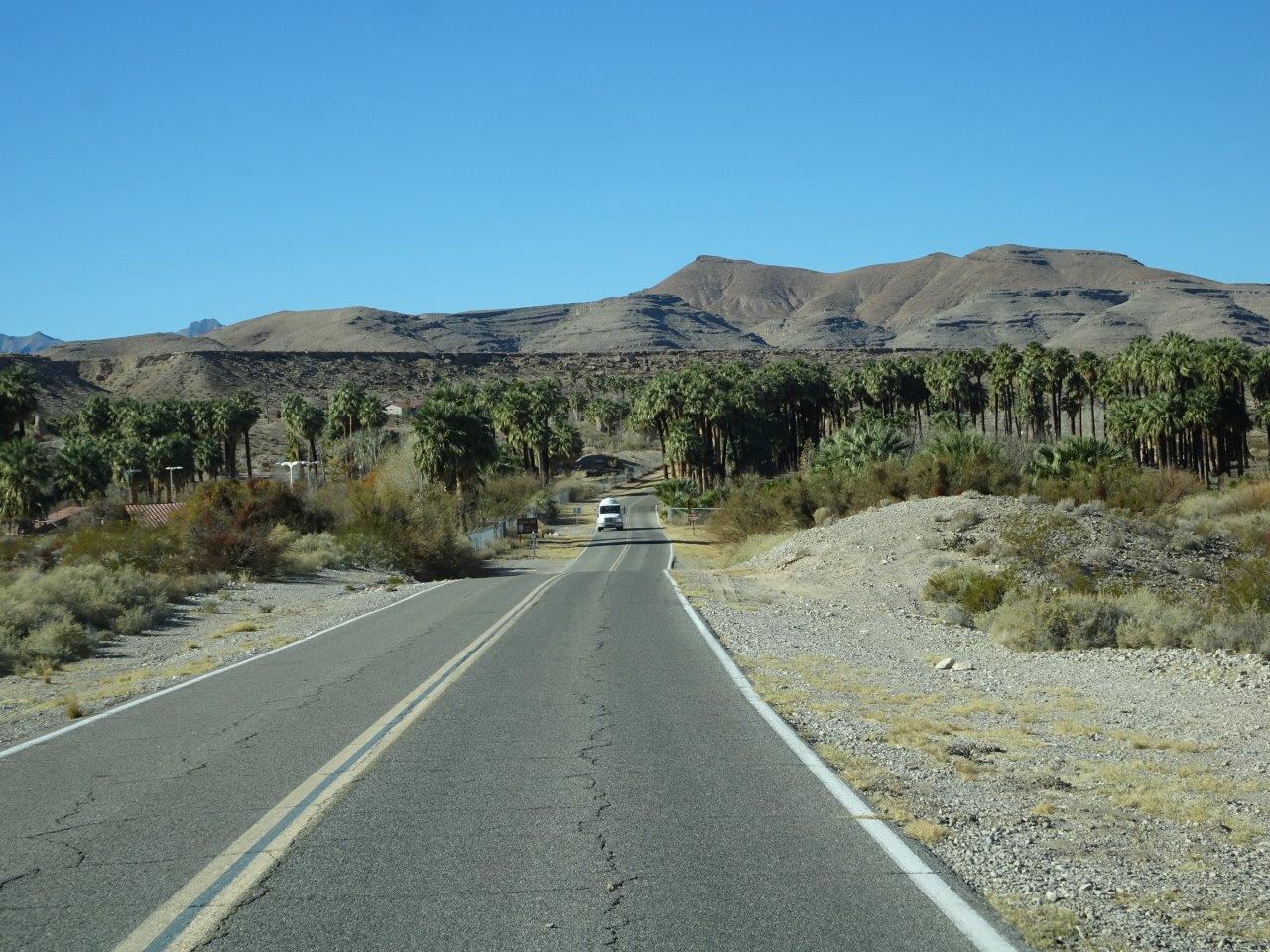
It was only about a 45 minute drive from Valley of Fire, and as I approached it, I could see what looked like an oasis in the desert with lots of palm trees.  I actually stopped right in the middle of the road to take this photo.

There was no one in the parking lot, so I had it all to myself.

You might have to enlarge this to read this sign, but basically it tells you that the thermal spring contains ancient water from underground rivers.  I will try to post portions so it is more readable. 


There used to be a swimming pool here until the federal government acquired the property.  They built in several windows and routed the stream past them so visitors could see the tiny endangered fish. 

There is at least one dace in this photo.  

 There are two hiding here.


I hiked up this path to a viewing area bench above the refuge.  The ranger drove by as I was sitting on a rock to rest down by the road and we chatted for a while.  The lady volunteer lives in that little house, and she also happened to stop by to tell the ranger to stop by to see her new motorhome.  You meet nice people in the strangest places!


Nice view of the small refuge and the desert valley.  

You can't see it clearly, but the spring originates in this small marshy area.

I am pretty sure these are California fan palms.  The native Americans ate the fruit and used them for many things.  Most of the palm trees you see today are Mexican fan palms and have a much thinner trunk.  California fan palms (Washingtonia filifera) have trunks that are 2-3' in diameter, grow up to 60' high, and are rare today.  (You can find them in Borrego Springs if you hike the oasis trail, which I have done and plan to do again this spring, except this time I will take my hiking stick and try not to fall into a cactus.)

See this article on fan palms:  https://www.desertusa.com/flora/california-fan-palm.html

As you can see, there is a lot more to southern Nevada than Las Vegas.  Ash Meadows is about an hour-and-a-half west of Las Vegas, Moapa Valley is about an hour north, and Pahranagat is about two hours north.  And Valley of Fire State Park is well worth a day trip when you are in this area.  


Friday, January 5, 2018

1/5 Bighorn Sheep Herd

I went out late this afternoon to take my payment envelope to the pay station to sign up for five more days in this lovely place. On my way, I found people watching and taking pictures of these five male bighorn sheep. I have seen piles of sheep poop and also hoof prints in the soft sand, so I knew they hung around this campground, but figured it was mostly at night or in the early morning. 

Not sure how this small group of bachelor males is related, but they seem to be all about the same size and age. They also look positively chubby for living in such a dry place. In the past in various places, I have seen small herds that consist of a large male and several smaller females. (The females also have smaller and thinner horns.) This is the first time I have seen a group of five, prime adult rams!  They should be out competing for females this time of year. 


Even while they were eating, at least one of them still had an eye on us.  These two are now eating sagebrush. 

They call them bighorn sheep for obvious reasons!  I wonder how much each set of horns weigh?  

Here is a video I took.  Sorry for the wobbly camera, but there was no place to steady it. 


1/4 Mouse's Tank Trail, Valley of Fire

Valley of Fire is not only a beautiful place, but Native Americans used the oxidized rock walls extensively as palates for their artwork.  These aren't rock paintings or "pictographs" because no "paint" was used.  Instead, the artist pecked at the black, oxidized faces of rocks with other stones to draw pictures.  The resulting artwork, or petroglyphs," last centuries, or until the rock falls off naturally.  

There are hundreds of rock faces in the park that have been used this way, and some are very close to the campground.  However, today, I drove up to Mouse's Tank Trail and walked this very easy trail back into the "tank."  A tank, by the way, is a depression in the rock that will hold rainfall for months or even years, so it was an important resource for the Native Americans.

The trail is flat and sandy, so the only problems in walking it were the stones that kept getting into my sandals.  Also had to be careful not to trip over rocks as I looked up for pictographs. 


No one knows for sure what these figures are, but they seem to be dancers holding hands.  Possibly the two figures on the left are wearing costumes.  

This large rock was just covered with petroglyphs!

This is a closeup.  The two symbols made up of a horizontal line with crooked lines coming down from it is supposed to mean rain.  There is also something that looks maybe like a millipede on the lower right. 

 The more weathered drawings, like these, are probably older. 

One interesting symbol is on the lower left.  It is a central circle with smaller circles surrounding it and connected by lines.  I saw similar images in several places.  Also note the two "feet" in the upper right and the snake. 

Not sure why one "foot" has five toes and the other has only four.  Or maybe these are hands without thumbs?  Or just a bad artist?  

And another circle image.  

More "feet"?  And more "rain"?  Looks like a couple of deer, also. 

The image in the upper right looks like it might be the sun.  And the deer is very clear.  Have no idea what symbols at bottom might be. 

A little bit of everything on this panel, but notice the "dancers" on the lower right. 

The path is about half a mile long.  One interesting thing is that nearly all the drawings were done on the sunny side of the canyon, or the north side, since the sun is shining mostly from the southeast or southwest.  This is looking back towards the entrance.

Headless "dancers"???

One of these dancers apparently has deer antlers on his head.

???????????

More dancers.  Dancers and animals were probably the most common symbols.

Could the the spotted thing be a turtle?  There were turtles in this area. The animal to the left of the deer looks maybe like a lizard. 

End of the trail at Mouse's Tank.  The depression in the lower center of the photo holds a rock "tank."

I tried but could not get down into the tank. You have to squeeze through a crack and drop down about five feet at the same time. It would have taken someone to help me down and a whole team to get me back up, so I decided to pass on this one!  But at least you can see how this depression could hold a lot of water.

Note: I went back into photos from December, 2013, and found this photo of water in the tank.
 

1/3 Valley of Fire State Park, Nevada

This is one of my favorite places in Nevada--actually one of my favorite places overall!  I have been here several times and enjoy coming back because of the quiet and beauty of the red rocks and all of the pictographs in this area.  Obviously, the Native Americans enjoyed this place for millennium, as well!

It is located about an hour north of Las Vegas, which is NOT one of my favorite places in Nevada!   The entrance road off I-15 can be a bit winding, but once you arrive, it is much easier.  The park gets its name from the red Aztec sandstone in the area.


Some great long views inside the park.

The rocks are soft sandstone and have a lot of holes in them which lend themselves to climbing.  These are some Japanese tourists who arrived by bus and were enjoying the area near the visitor center. 

This formation is near the campground and looks like an arch in formation. 

Glad that they did not put any campsites under this rock because it looks as if it could fall at any moment. 

This rock looks even more precarious, but at least it is smaller.

One of the prettiest campgrounds anywhere!  It can be really hot here, but today it was a little chilly with highs of only 60 and lows at night in the upper 30s.  

Some of the formations are yellow or white, as you can see here.


The sandstone was formed by sand dunes, and often you can see the patterns in the sand. This area had some sandstone that looked lavender.

Lots of shapes in the sand here.


Very pretty drive down into the valley from the higher areas.


Sunday, December 31, 2017

12/31 Happy New Year & a Year-End Summary


Instead of sending out a Christmas letter, I put thing together as a summary of the past year.  Here are some statistics:

  • I started 2017 in Florida, and then headed to Ohio in April.  After visiting with family and friends in Ohio and Michigan, I headed west to California, via Indiana, Illinois, Missouri, Kansas, Colorado, and finally Grand Canyon in Arizona where I met my son and his family for a few days.  Next was Utah, and finally back to Colorado to find some cooler temps in higher altitudes.  After several weeks at elevations from 7,500’ to 9,600’ in western Colorado, I headed north to Oregon and then down to northeast California to meet up with some other solo women RVers.  
  • I ended up driving 17,581 miles in 2017, about 4,000 miles less than in 2016.  I have been trying to save money by staying in places longer and staying at more federal campgrounds where I get a discount.  I used 2,234 gallons of gas this past year, which cost me $5,734.  Expensive, but it is not cheap to haul your home and all your belongings all over the country.  I also spent a lot of money on campgrounds, but camping fees averages out to about what you would spend on a mortgage for a home. 
  • I spent only $299 on propane this past year to heat water, run furnace, cook, and run my refrigerator while driving.  That compares to $218 in 2016, $230 in 2015, and $365 in 2014.  A tank of propane costs me about $30 and lasts about 6 weeks unless it is very cold outside.  Since I spent a lot of the fall and early winter in cold places, the increase makes sense. 
  • I thought I spent a lot of money on maintenance last year, but I ended up spending even more in 2017—a total of over $6,000.  The biggest expenditures were for slide roller repairs and all new brakes.  And, I broke my own record for replacing the house water pump once a year—this year, I had to get it replaced twice.  Most people have no problems with water pumps lasting several years, but mine seem to be constantly failing.  
  • Water use stayed the same.  I average about 10 gallons of water per day for a hot shower and washing dishes once a day, so that totals about 3,650 gallons per year, which is a lot less than the average person uses.  You tend to conserve water when you have to drive to a dump station and empty it down the sewer yourself.  

While all of this sounds horribly expensive, remember that I have no other vehicles other than my motorhome.  In addition, I do not pay property taxes or utility bills, and I don't own a house or condo with maintenance costs.  Since I am retired, I don't need clothes or shoes for work, nor do I have to commute to an office.  And I have not bought winter clothing for years! 

I am still very much enjoying this life and have no intentions to quit.  I visited with some cousins in Florida this winter and also got together with some other RVing women in Tampa, Arizona, Eagle Lake in northern California, and in San Diego.